

Hardwood timber
Jurisprudence
By
Dahlia Lithwick
Enter your email to receive alerts for this author.
Sign in or create an account to better manage your email preferences.
Unsubscribe from email alerts
Are you sure you want to unsubscribe from email alerts for Dahlia Lithwick?
Nov 18, 20255:31 PM
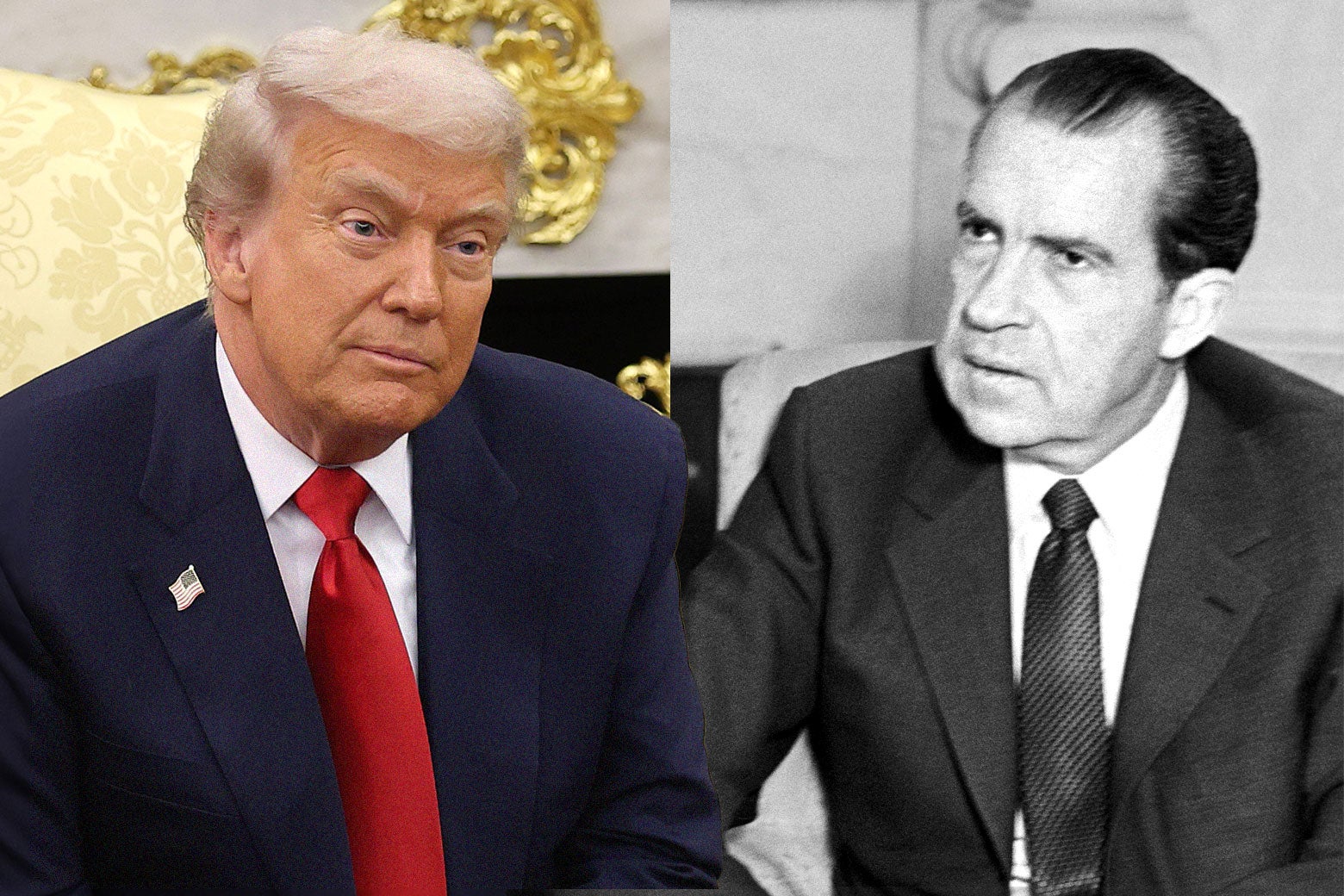
Photo illustration by Slate. Photos by Win McNamee/Getty Images and UPI/AFP via Getty Images.
Sign up for the Slatest to get the most insightful analysis, criticism, and advice out there, delivered to your inbox daily.
Judge Mark L. Wolf served on the federal bench for 40 years, but this month he announced his retirement, followed by a searing explanation, published in the Atlantic, of why he had decided to leave the judiciary. Five decades after he entered a Justice Department still reeling from the Watergate scandals, Wolf says he couldn’t bear to be silent about what the Trump administration has done to the rule of law and the DOJ any longer. In his first podcast interview, Judge Wolf explained his decision to break his silence to Dahlia Lithwick on last week’s Amicus. The following transcript has been edited and condensed for clarity.
Dahlia Lithwick: Can you talk about how it came to the point where you felt you could no longer do the work of being a judge in this atmosphere?
Judge Mark Wolf: It was really an accumulation of things. Beginning last February, shortly after President Trump took office, a number of people I respect, including some federal judges, began urging me to retire and to speak out. They felt that as a result of my career, perhaps my reputation, the coincidence that I was appointed by Ronald Reagan, I would have some special stature to be heard in this cacophony of complaining voices. I was skeptical and I was reluctant, because I loved being a judge. I expected to do it as long as I was cognitively and physically able to do it. But it was the almost daily, outrageous, egregious things that the president and members of his administration were doing, things that are an assault on the rule of law, and democracy, and the fundamental ideal of equal justice under law, that finally led me to agree that I couldn’t any longer bear to be silent.
While I wasn’t at all confident that I’d have an opportunity to be heard, or that it would have any impact, I felt it was essential to join others and try to do anything I can to protect the rule of law, the democracy, and to advocate for judges who essentially are muzzled—properly muzzled—by the code of conduct for United States judges, which prohibits saying anything that could call a judge’s impartiality into question.
Your career has involved many years on the bench, but prior to that, you worked in the Justice Department. Can we scroll back to 1975, soon after you joined DOJ? The department was reeling in the wake of Watergate. Attorney General Edward Levi gave an induction speech to the Justice Department in which he said, “Nothing can more weaken the quality of life or more imperil the realization of the goals we all hold dear than our failure to make clear by word and deed that our law is not an instrument of partisan purpose.” It’s so clear that this was really formative for you in your thinking about what the Justice Department did. What was the significance of the reforms put in place by you and your colleagues in the wake of Watergate? What are the things that we take for granted that you had to muscle into place in order to regain the trust of the American people?
I read that induction speech before AG Levi gave it, because I was working for the deputy attorney general and organized his induction at the Justice Department on short notice, and in it he also said that if we’re going to have a government of laws and not men, then it takes men and women dedicated to being zealous, but also being fair, to make clear that the law is not an instrument of partisan purpose. I served for two years as one of his four or five young special assistants. We were 28, 29 years old, and I saw him faithful to that principle every day, and that did have a profound impact on the way I later served as a prosecutor, in particular as a prosecutor of corrupt public officials, but also a steward of the U.S. Attorney’s Office in Massachusetts and then later as a judge.
There were a number of reforms that were put into place after Watergate, especially for the FBI. The director for decades, J. Edgar Hoover, had promulgated enormous abuses of the bureau. So AG Levi overhauled guidelines for the use of informants. (Later, I ended up spending nine months and writing a 661 page decision as a judge when the FBI violated those guidelines and protected their organized-crime informants, and indeed were involved in murders by those informants, in the cases of James “Whitey” Bulger and Stevie Flemmi.)
There were new restrictions on investigations of First Amendment activity, peaceful protests by adversaries to the president perhaps, or adversaries to the FBI—the kind of people J. Edgar Hoover didn’t like.
But much more important than any reform to the institution was a change in culture at the Department of Justice. When President Ford selected Edward Levi—the president of the University of Chicago, with a richly deserved reputation for brilliance, integrity, impartiality and nonpartisanship—President Ford told him, I want you to be an attorney general who protects the interests and the rights of the American people, not one who looks out for the interests of the president. A number of guidelines would develop that restricted communications between the White House and the Justice Department, and limited the number of people who could have those communications. So many of the harms caused in Watergate stemmed from Attorney General John Mitchell (who was also President Nixon’s campaign manager in the 1972 election) authorizing the criminal break-in of the Democratic headquarters at the Watergate Complex and lying about it in the cover-ups that followed. There was a recognition that Attorney General Levi was right, that the Department of Justice should never be used for partisan purposes, and it would be devastating to democracy if it was.
We’ve had almost 50 years where the ethic Levi instilled has substantially survived. You would hear presidents say, I didn’t direct the Department of Justice to do this or that. I didn’t prohibit them from doing this or that—in line with that ethic. What Donald Trump is doing is diametrically the opposite. What Richard Nixon did periodically and secretly because he knew it was illegal or improper, President Trump does repeatedly, regularly, and openly. That is profoundly disturbing. It’s utterly inconsistent with the fundamental ideal of our country, of equal justice under law.
That is such a useful corrective for people like myself who don’t remember Watergate, and who think that the state of nature is what came after that; people who may believe it has always been the case that there were ethics and rules and norms about having a real separation between the Justice Department and the White House, and ethics and rules and norms around how prosecutors conduct themselves. It’s a useful corrective for me to understand that the state of nature actually is the pull toward corruption and the pull toward self-dealing. It’s why you have to have this edifice and why it needs to be worked on constantly.
Both as a prosecutor and on the bench, you were deeply involved in high-profile corruption cases. Corruption is a thing that you know very well. And we are seeing such egregious corruption now. The combination of enriching the Trump family, and the pay-to-play access, and the pardons, and the conferring of immunity on the one hand, and targeted prosecutions on the other … the list goes on. How does this conversation we are now having about Jeffrey Epstein and the cover-up map onto your thinking about corruption?
If I can apologize for sounding like a judge, which I was until a couple days ago, I would say it’s possible corruption. From my perspective, it is profoundly disturbing that conduct that would prompt serious investigation in any other era is not being investigated. It would have to be investigated in order to see whether there is sufficient evidence of corruption to bring a case, and then if there is, you try the case. I’m reserving judgment on what is or is not corrupt, but there is conduct that would trigger an investigation.
I haven’t had time to read very much of the coverage about the Epstein files. I do understand why for political reasons, and maybe some principle reasons, there is interest in Jeffrey Epstein. But to me, it’s not nearly as important to the rule of law and the future of democracy as something that’s not receiving, in my view, adequate attention. And that is the information concerning Tom Homan, the “border czar” at the Department of Homeland Security. It’s been reported that before the election, the FBI had an undercover investigation, and in that undercover investigation, they met with Homan. They reportedly said that they wanted him to use his future influence, if Trump was elected, to get lucrative contracts for this fictitious company, and they gave him a bag of cash with $50,000 in it, and he took it. That is what has been reported.
Trump got elected and appointed Homan to a very high position in the Department of Homeland Security, a very important role in this administration. Homan is in charge of getting people who’ve committed crimes in this country and are here illegally out of the country in high numbers. In any ordinary time, the FBI would’ve continued that undercover operation and the undercover operative would’ve gone to see Homan and offered him more money. The FBI would’ve seen what happened, tape-recorded it, and structured the investigation to develop compelling evidence in court. I used to participate in these investigations, I used to help shape them when I was a prosecutor.
That’s not what happened. Shortly after President Trump was elected, the Department of Justice closed that case. The White House said there’s no credible evidence of criminal activity. They didn’t say there’s no evidence—they decided the credibility of it, which usually juries decide. Initially Homan said he didn’t do anything illegal; subsequently he said he didn’t take $50,000 in cash. He’s quoted, it’s in the media. I don’t know whether there was a legitimate purpose for taking $50,000, I don’t know if he actually took $50,000, but what I don’t understand is why the Congress isn’t saying “We want the Homan tapes.” I’m totally nonpartisan; to me, this is not political. Based on my experience working for the deputy attorney general and the attorney general, the Department of Justice will not turn over to Congress evidence developed in an open criminal investigation, but it has on a number of occasions, and I dealt with this 50 years ago, responded to Congress by turning over evidence that was developed in closed investigations. Back then, Congress was investigating whether the undercover operations or the criminal investigations were properly closed. I think if Congress, the Senate, the House asked for the Homan tapes, there would be pretty consistent precedent for the Department of Justice to turn it over. Then, having heard and seen the evidence, the American people could see whether this border czar, who is a leader in the effort of punishing criminals and getting them out of the country, has possibly engaged in criminal activity himself.
Get the best of news and politics
Sign up for Slate’s evening newsletter.
Department of Justice
Donald Trump
Jurisprudence
Slate Plus
Richard Nixon
Judiciary