

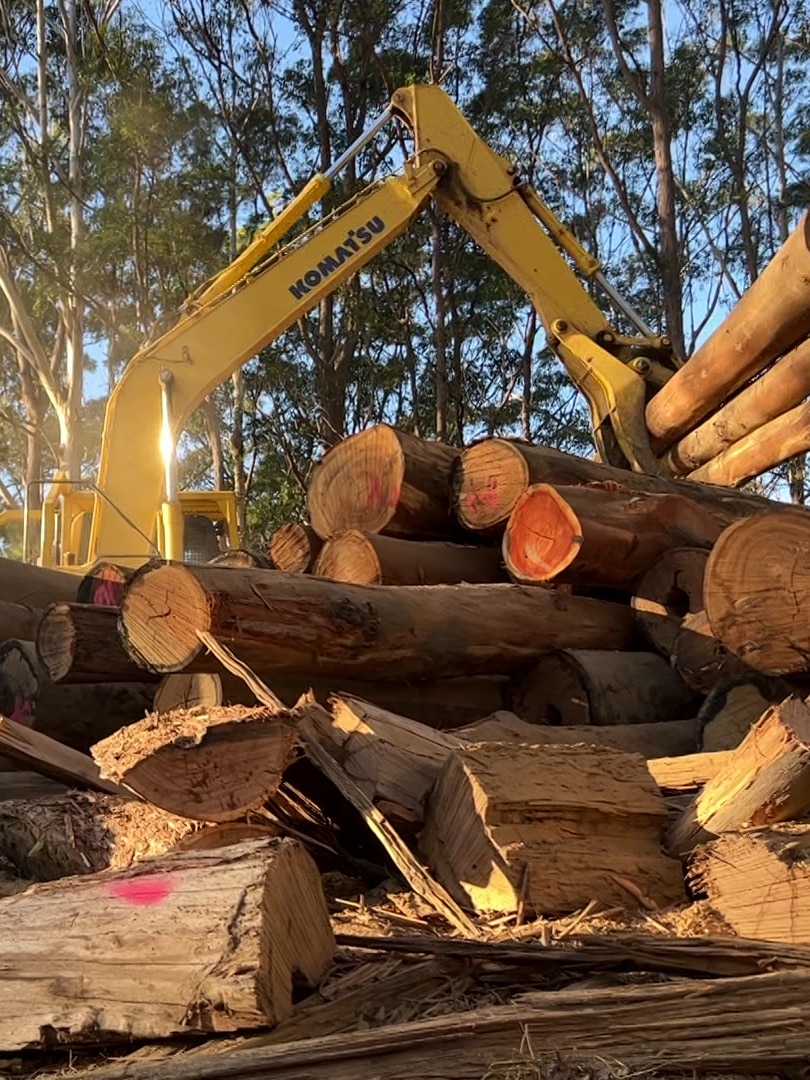
Hardwood timber
Two Australian states have shut down native forestry in the past three years, leaving the NSW industry chasing assurances from the state government it will not be next.
The NSW government last year introduced a logging moratorium on 176,000 hectares of state forest earmarked for the proposed Great Koala National Park in north-eastern NSW.
The move came almost two years after native forest logging ceased in Western Australia and Victoria.
Timber workers and industry representatives from across NSW are calling on the state government to release its strategy for the domestic hardwood sector to ensure there is enough timber for the housing industry.
“We’re seeing right now what happens when you just offshore capacity; we let our fuel refineries go offshore, in times of strife, the boats don’t come,” Timber NSW president and mill owner Andrew Hurford said.
Hurford Hardwood owner Andrew Hurford is calling for a secure industry for the future. (ABC Landline: Cameron Lang)
Mr Hurford also pointed to private forestry on farmland as a significant potential source of hardwood, but said the need to get both local council and state government approval made it too expensive.
Landholders in NSW are required to submit a plan to Local Land Services if they want to harvest timber, but some councils also require a development application.
“You’re looking at landholders having to front up with $50–80,000 to complete an approval with local council with no surety that they’ll actually get that approval,” Mr Hurford said.
“Most rural activities, rural production does not require a separate approval from the local council … and I don’t believe timber should be any different.”
Industry representatives are calling for a secure future for the Australian hardwood sector. (Supplied)
The Timber, Furnishings and Textile Union (TFTU) said the state government was planning to release its forest strategy in the next few weeks but that has not been confirmed.
In a statement, a NSW government spokesperson said it was “committed to delivering a Forestry Industry Action Plan that will outline a pathway to a sustainable timber industry in NSW”, but would not comment on specific measures being considered or a timeframe for delivery.
‘Jobs versus koalas’
Environment group the Bob Brown Foundation is calling for an end to native logging in Australia.
Campaign manager Jenny Weber said: “Protecting intact forests is critical for climate stability, for clean water, recycling rainfall, anchoring the soil, they’re powerful tools for protecting against climate change.”
She said endangered species were losing their habitat due to logging in NSW.
“Nationally important koala habitat is being logged from Bulga State Forest north of Newcastle to Cherry Tree State Forest inland from Lismore.”
Despite the concern from environment groups, TFTU state secretary Alison Rudman said koalas and a native forestry industry could coexist.
Alison Rudman says “good policy” can work for jobs and koalas. (Supplied: Timber, Furnishing and Textile Union)
“Since the announcement of the Great Koala National Park, the NSW government’s own koala survey has come out which shows that there are hundreds of thousands more koalas than first thought, and this is a good thing,” Ms Rudman said.
“We don’t think the discussion should be jobs versus koalas. Good policy will deliver both.”
A CSIRO report from 2025 found that koala numbers were three times larger than previously thought, while a NSW government survey from last year estimated there were around 10,000–14,000 koalas in areas of the state forest that had been logged, similar to adjacent sites in the national park where logging was prohibited.
“That’s after a century of timber production, but for some reason we had to move it into a national park [when] the populations in the neighbouring national park was about the same,” Mr Hurford said.
The NSW government says the Great Koala National Park is crucial to protecting the state’s koala population and other threatened fauna species.
A koala on Andrew Hurford’s forestry property in northern NSW. (Supplied: Andrew Hurford)
Mr Hurford said a better way to protect koalas was to focus on fire management, not selective harvesting.
“One of the major impediments to koala populations is time since last wildfire, so what we really should be trying to do is say how do we manage this land so we don’t get a wildfire?”
Research published in 2022 by the NSW DPI in Scientific Reports found that regulated harvesting of forests with environmental protections could be compatible with koala conservation, while an associated study found that more severe fires had a greater impact on koala numbers.
Mr Hurford said logging was actually beneficial to koalas because it helped manage the fire risk in forests.
“Should we mechanically remove some of that fuel load, should we be doing low-temperature burns in the cool season, should we at least be creating a mosaic of forest where you have old-growth forest, you have rainforest, you have young regrowth?”
Environmental opposition
Ms Weber argued that native forest logging increased fire risk.
“There’s compelling evidence that Australia’s historical and contemporary logging regimes have made many Australian forests more fire-prone,” she said.
Jenny Weber is calling for an end to native forest logging. (Supplied: Jenny Weber)
Narooma mill worker Ben Nunn has been in the industry for 10 years.
Ben Nunn says the industry is highly regulated. (Supplied: TFTU)
He said he was frustrated by what he described as misinformation about native logging, arguing the industry was highly regulated.
“We don’t clear-fell at all, it’s regulated, it’s five in every 10,000 trees, it’s not old-growth, there’s certain areas you can, there’s certain restrictions, like you’ve got to look out for your animals,” he said.